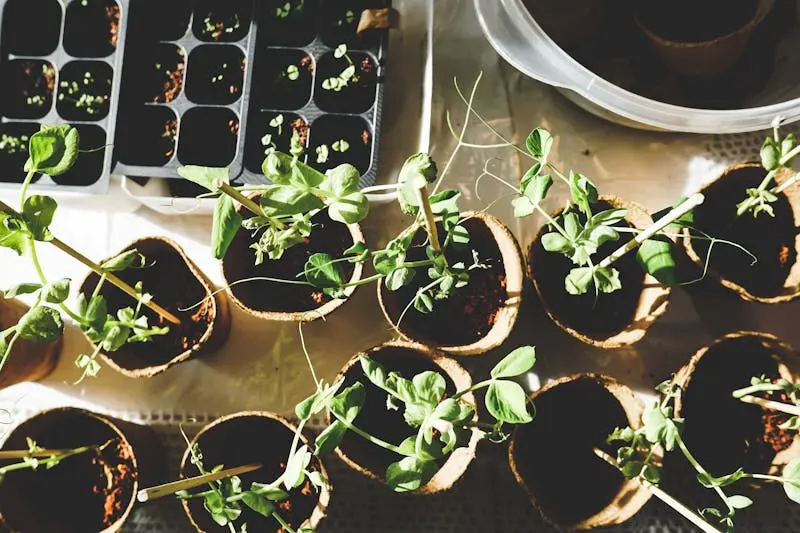
What you need to sow seeds indoors
The kit that actually matters, the stuff you can skip, and what we'd spend our own money on.
You don't need much to start seeds. A warm windowsill, a bag of compost, and something to put it in. That's genuinely it for most crops.
But there are a few things that make the difference between seedlings that thrive and seedlings that keel over after a fortnight. This is what we'd actually spend money on — and what we wouldn't.
Affiliate links— Some links go to Amazon. If you buy through them, a little goes towards the allotment shed, at no extra cost to you. We only recommend things we'd actually use on our own plot.
Trays and modules
Module trays beat open seed trays for almost everything. Each seedling gets its own root space, so you can plant them out without disturbing the roots. The 24-cell or 40-cell trays are the most versatile size.
Nutley's 24-cell module trays
~£6 for 3The workhorse. Big enough for most seeds, small enough to fit on a windowsill. Nutley's are thicker plastic than the cheap ones — they last years and have proper drainage holes. Get a solid base tray underneath to catch water.
3 trays gives you 72 cells — enough for most beginners. Buy 2 packs for a serious season.
Charles Dowding CD60 module trays
~£10The trays Charles Dowding uses every day. 60 tapered cells with wide drainage holes — the rootballs slide out without sticking or tearing. Made from thick recycled polypropylene that lasts years. More expensive than standard trays but if you're sowing seriously, the difference in ease of use is worth it.
Also available in CD30 (bigger cells) and CD15 (big seeds like beans and squash).
Full-size seed trays with drainage
~£8 for 5If you're sowing a lot of one thing (like lettuce or spring onions), open trays are cheaper. Scatter sow, then prick out into modules once they're big enough. More faff, but you get more plants per tray.
Compare Full-size seed trays with drainage9cm square pots
~£6 for 20For bigger seeds — courgettes, squash, sweetcorn, beans. These need more root room from the start. 9cm pots are the perfect size: big enough for the seedling to develop a proper root system before planting out.
Also useful for potting on seedlings from modules.
Compost
This is the one thing worth getting right. The wrong compost is the most common reason seeds fail to germinate or seedlings dampen off.
Levington Seed & Cutting Compost (20L)
~£6Fine, low-nutrient, free-draining. Exactly what tiny seedlings need. Levington is peat-free and widely available. Don't use multi-purpose for small seeds — it's too chunky and too rich. The seedlings drown or get burned.
One 20L bag does about 10 full trays — it goes further than you'd think.
Multi-purpose compost
~£6 for 40LFine for large seeds (beans, squash, sweetcorn) and for potting on. Not ideal for small seeds. When potting on, mix in some perlite for drainage if it feels heavy and wet.
Compare Multi-purpose compostVermiculite
~£5 for 10LA light covering over surface-sown seeds keeps them moist without burying them. Also brilliant for mixing into compost to improve drainage. Not essential, but useful to have around.
Compare VermiculitePropagation
Seeds need moisture and warmth to germinate. A lid or cover traps both. You don't need anything fancy — but for heat-loving crops like peppers and chillies, a heated propagator genuinely makes a difference.
Clear propagator lids
~£6 for 5Plastic lids that sit on standard seed trays. Trap moisture and warmth, creating a mini greenhouse effect. Remove as soon as seeds germinate — seedlings need air circulation or they'll dampen off.
Cling film over a tray does the same job in a pinch.
Garland One Top heated propagator
~£25A small electric mat in the base that provides consistent bottom heat (around 22–25°C). The Garland One Top is the one everyone recommends — simple, reliable, fits a standard tray. Worth it for peppers, chillies, and aubergines — they need warmth to germinate and a cold windowsill at night can stall them for weeks.
Not necessary for tomatoes, lettuce, or anything hardy — just the heat-lovers.
Heat mat
£12–20A flexible heating pad you put under your trays. Does the same job as a heated propagator but cheaper, and you can use your own trays and lids. Look for ones with a thermostat — without one they can run too hot.
Compare Heat matWatering
Overwatering kills more seedlings than underwatering. Bottom-watering is the safest approach — let the compost draw water up rather than pouring it on top.
Small watering can with fine rose
~£8A 1–2 litre can with a fine brass rose gives a gentle shower that won't flatten seedlings. Much better than using a jug or mug. The Haws Indoor can is beautiful if you want to treat yourself, but any small can with a rose works.
Compare Small watering can with fine roseSpray bottle
~£3A fine mist spray bottle is handy for misting the surface of seed trays and freshly pricked-out seedlings. Gentler than any watering can. Get one from the pound shop.
Compare Spray bottleLabels
You will not remember what you sowed where. You think you will. You won't.
White plastic plant labels
~£3 for 50Cheap, simple, effective. Write the variety and date sown on each one. Buy more than you think you need.
Always use a pencil, not a marker — markers fade in sunlight within weeks.
Wooden lolly stick labels
~£3 for 100Biodegradable alternative. Work fine for indoor seedlings. They can go a bit mouldy in damp conditions outdoors, but for the windowsill they're great.
Compare Wooden lolly stick labelsLight
Seeds don't need light to germinate — they need warmth. But once they're up, light is everything. Leggy, pale seedlings are always a light problem. A bright south-facing windowsill is usually enough. If yours isn't, or if you're starting early in the year when daylight hours are short, a grow light helps.
LED grow light strip
£15–25A simple LED strip on a timer gives seedlings consistent light without the leggy stretch you get on a windowsill. Not essential if you have a good south-facing window, but a game-changer if you don't. Set it 5–10cm above the seedlings and run it for 14–16 hours a day.
Look for full-spectrum or 6500K — avoid the purple/pink ones, they're designed for flowering plants.
Potting on
Once seedlings outgrow their modules, they need potting on into bigger pots. You'll know it's time when roots poke out the bottom or growth stalls.
1-litre pots
~£6 for 20The next step up from modules for most seedlings. Tomatoes, peppers, and courgettes will spend a few weeks in these before planting out or moving up again.
Compare 1-litre potsPerlite
~£6 for 10LMix a handful into your potting compost to improve drainage and aeration. Particularly useful if your multi-purpose compost feels heavy and waterlogged. Not essential, but cheap and makes a noticeable difference.
Compare PerliteThat's everything you need to fill a windowsill with seedlings. The seeds themselves cost £2–3 a packet and each packet grows dozens of plants.
The full shopping list
Everything you need to start seeds indoors, from the essentials to the nice-to-haves.
Essentials (~£30)
- 24-cell module trays (x5)~£8
- 9cm square pots (x20)~£6
- Seed compost (20L)~£5
- Propagator lids (x5)~£6
- Plant labels (x50)~£3
- Spray bottle~£3
Worth the upgrade (~£45 extra)
- Heated propagator or heat mat£15–30
- LED grow light strip£15–25
- Small watering can with rose~£8
More tools and guides
The full guide to sowing, germination, and hardening off.
The tools, materials, and kit that actually matter.
Enter what you've sown and we'll tell you when to harvest.
Personalised sowing dates for your postcode.